It's 7:45 on a Monday morning. Your day shift DSP just called out, the replacement staff member walked in five minutes ago, and now they're standing in front of the medication cart trying to figure out where to document that they gave Mr. Johnson his 8 a.m. meds. The MAR binder is missing a page. No one can find last month's file. And your DBHDS licensing renewal is in six weeks.
Sound familiar?
Medication administration records are one of the most commonly cited areas during DBHDS audits of DD waiver group homes and one of the most preventable. A compliant MAR system doesn't require expensive software or hours of staff training. It requires a clear structure, consistent habits, and documentation that tells the whole story even when you're not in the room.
This guide walks you through exactly how to build that system.
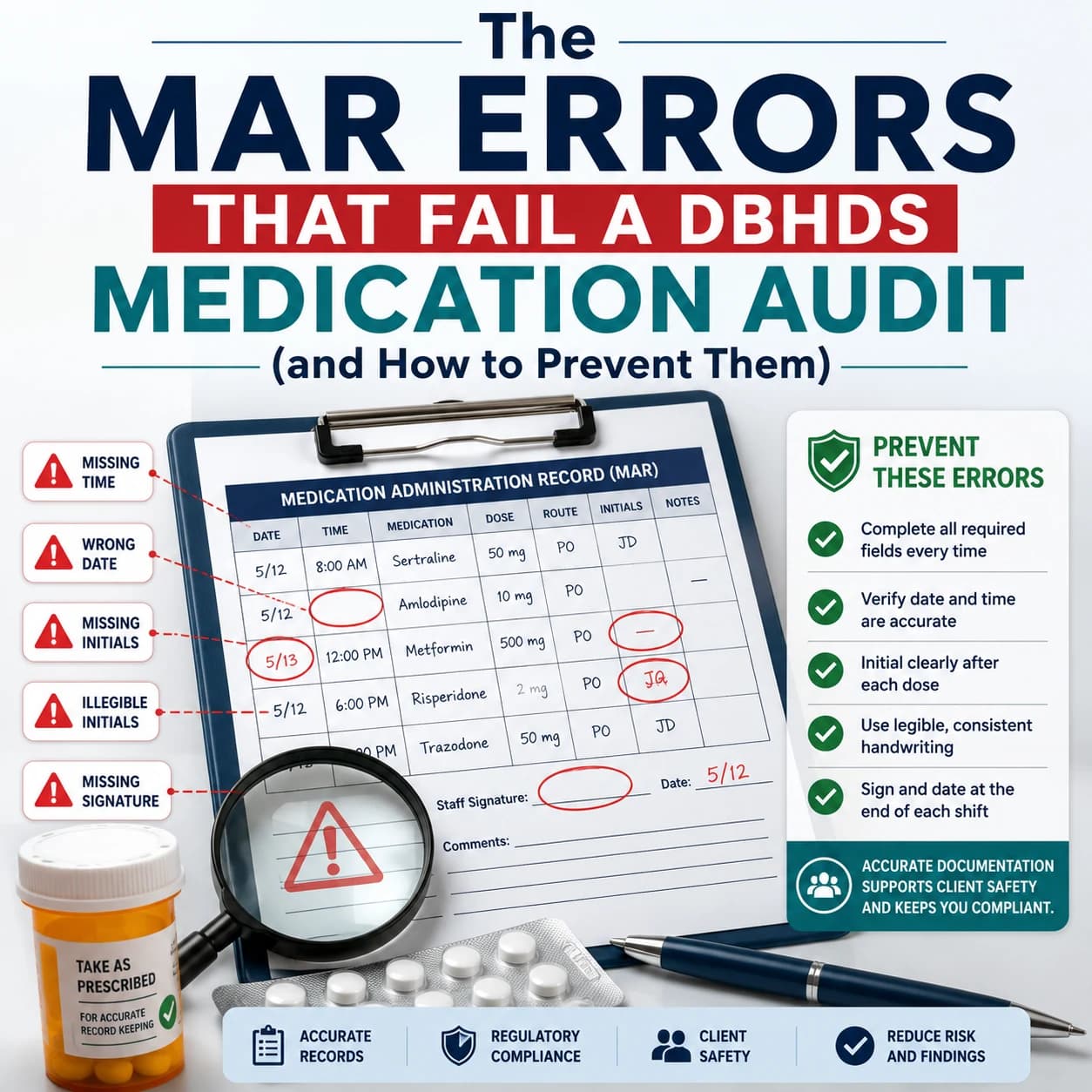
What Virginia DD Waiver Regulations Require for Medication Documentation
Before you can build a compliant system, you need to understand what “compliant” actually means in Virginia. DD waiver providers operating group homes are subject to DBHDS licensing standards, and those standards are specific about medication documentation.
At minimum, your MAR must capture:
- The individual's full name
- The medication name, dose, route, and frequency
- The prescribing physician's name
- The date and time each dose was administered (or refused/missed)
- The initials of the staff member who administered or observed self-administration
- Any relevant observations or side effects noted at time of administration
Regulations also require that MARs be maintained for each active medication, that discontinued medications are noted with a date and reason, and that PRN (as-needed) medications include documentation of the specific reason administered and the outcome.
Common citation triggers
Missing staff initials, undocumented PRN rationale, gaps in documentation with no explanation, and MARs that don't match the current physician orders are the four most frequent findings when reviewing provider records.
Paper vs. Electronic MAR: Choosing the Right Format
Many Virginia group homes still use paper MARs, and paper is absolutely permissible under DBHDS licensing standards. The question isn't paper vs. electronic it's whether your chosen format supports consistent, legible, and complete documentation.
Paper MAR systems
Paper MARs work well for smaller homes with stable medication regimens. If you go paper:
- Use a pre-formatted template that includes all required fields don't let staff create their own
- Print a new MAR at the start of each month and before any medication changes
- Keep a blank correction procedure posted near the med cart: single line through errors, initials, date, and a brief note never use white-out
- Store completed MARs in a locked location accessible to authorized staff for the required retention period (at least two years in Virginia)
Electronic MAR systems
Electronic systems reduce transcription errors, make audits faster, and create automatic timestamps all of which help during a DBHDS review. If you use an electronic system, verify that it:
- Requires individual login credentials for each staff member (no shared passwords)
- Creates an unalterable audit trail with timestamps
- Allows you to export records in a format acceptable to DBHDS
Whether you use paper or electronic, the documentation standard is the same: if it isn't written down, it didn't happen.
Building Your MAR System: A Step-by-Step Setup Guide
Here's how to get a functional, DBHDS-ready MAR system in place or tighten up an existing one.
Step 1: Audit your current medication orders
Pull every individual's current physician orders and compare them to what's on your MARs. Discrepancies between orders and MARs are a red flag during audits. For each medication, confirm:
- Name, dose, route, and frequency match the current order exactly
- Orders are signed and dated
- Any discontinued medications from the last 12 months are properly archived
Step 2: Create a consistent MAR template
Your MAR template should require staff to document every field on every line not leave blanks for “nothing to report.” Create a template that matches your home's specific medication schedule. If you have individuals with complex regimens, consider person-specific MARs rather than a shared group format.
Step 3: Establish your monthly MAR cycle
Designate who prepares new MARs each month and by what deadline (we recommend the 25th of the prior month). Build in a supervisor review step before the new MAR goes live. This catches transcription errors before they become documentation gaps.
Step 4: Train every med-certified staff member on your system
Even staff who have worked in group homes before may have used different documentation formats. Walk every authorized staff member through your specific MAR template, your error correction procedure, and your PRN documentation requirements. Document that training. If a surveyor asks “did your staff know how to use this MAR?”, you want a sign-in sheet for a training session not just someone's word.
Step 5: Build a daily reconciliation habit
At shift change, the outgoing staff member should verify that every medication administration for their shift is documented before they leave. This five-minute habit catches omissions while memory is fresh. Build it into your shift change checklist.
What Surveyors Actually Look for in Your MARs
When a DBHDS surveyor reviews your medication documentation, they're not just scanning for missing signatures. They're constructing a narrative: does this record tell a coherent story of this person's care?
They will look for:
Gaps with no explanation
A blank where documentation should be with no note explaining why reads as a missed dose or a documentation failure. Either way, it's a problem.
PRN meds without rationale
"Tylenol given" is not sufficient. "Tylenol given per individual's request for headache; individual reported relief 30 minutes later" is.
Initials that don't match staff records
Surveyors cross-reference staff initials against personnel files. If they can't identify who administered a medication, the documentation is effectively void.
Inconsistency between the MAR and medication count
If your pill count doesn't match what's documented as administered, that discrepancy must be explained.
How CareHub Simplifies MAR Compliance
We built CareHub because our team needed it. After years of watching providers get cited for documentation gaps that had nothing to do with the quality of care they were providing just the quality of their paperwork we wanted a better way.
CareHub helps DD waiver group homes manage medication documentation as part of a complete compliance record. Instead of hunting through binders to verify that everything is in order before a licensing review, you can pull a complete documentation summary for any individual in minutes.
When medication orders change, CareHub prompts the documentation updates that need to follow so a new prescription doesn't sit in an email while the MAR still reflects last month's orders.
See how much documentation time your team can get back
Start your free 14-day trial at CareHub no credit card required.
Try CareHub Free for 14 DaysKey Takeaways
A compliant MAR system isn't about paperwork for paperwork's sake it's about creating a record that tells the truth about the care your residents receive. That means consistent templates, trained staff, a monthly preparation cycle, and a daily habit of verification.
The providers we've seen get cited for medication documentation issues almost always had staff who were doing the right things clinically. The gap was in capturing it correctly. Close that gap before a surveyor does it for you.
What's the biggest MAR challenge your organization deals with staff compliance with documentation, managing medication changes, or something else? Tell us in the comments.
Tags